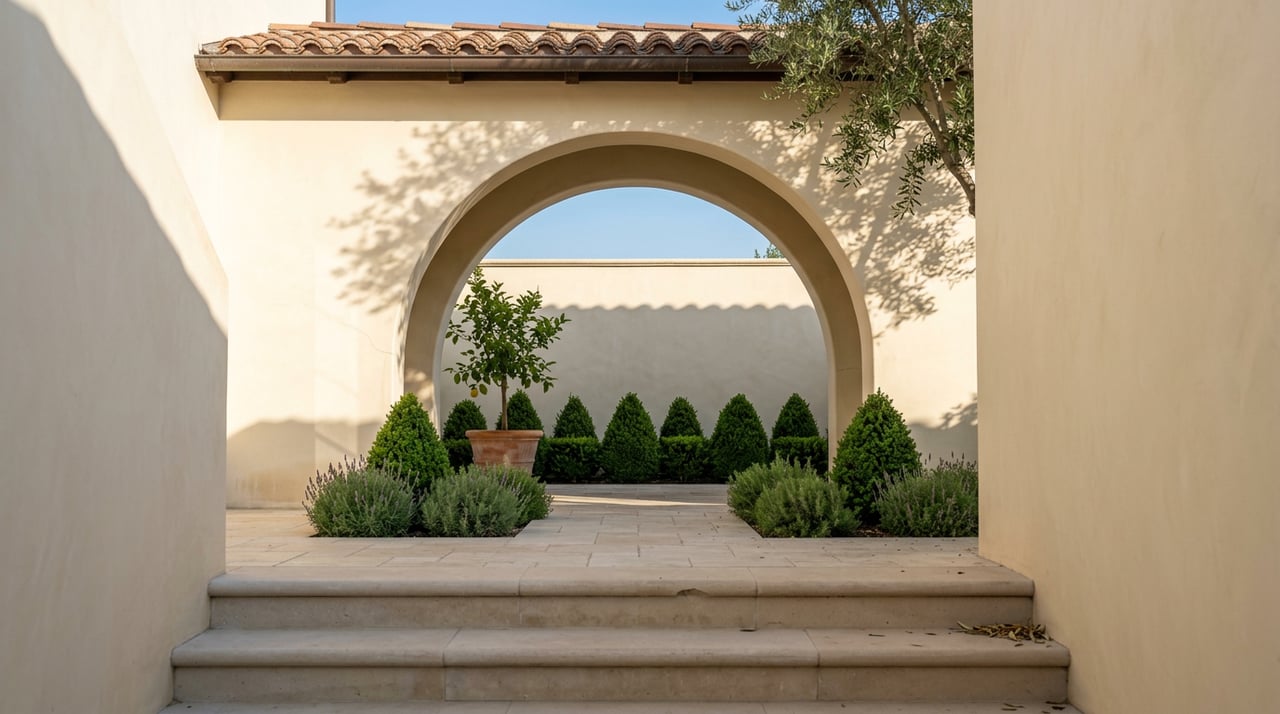
Two estates come to market the same weekend. Both sit on roughly two acres in the flats south of East Valley Road. Both are Mediterranean, both photograph beautifully, both are priced within a few hundred thousand dollars of each other. One will support a restored formal garden, an expanded pool, and a permitted guesthouse without a fight. The other will not, and the difference has almost nothing to do with the lot lines or the architecture.
The difference is the water meter. In Montecito, the meter attached to a parcel carries an entitlement history, a size, and a set of obligations that quietly govern what a buyer can build, plant, and refill after closing. That entitlement is priced into no listing, appears in no photograph, and rarely surfaces in a summary walkthrough. It surfaces in escrow, and sometimes only after.
The meter is the entitlement, not the lot
The Montecito Water District serves roughly 12,010 residents across Montecito and Summerland through about 4,600 service connections. That count has barely moved in a decade, and for a specific reason: the District has spent much of its modern history under either a formal meter moratorium or a de facto one. New meters were paused during the 1970s drought, again during the 1987 to 1991 drought, and again during the water shortage emergency declared in 2014. The 1997 lift on the moratorium followed the arrival of State Water Project deliveries in 1999, and the current supply confidence rests on the 50-year Water Supply Agreement executed with the City of Santa Barbara in September 2020, with deliveries from the Charles E. Meyer Desalination Plant beginning in January 2022.
What that history produced is an inventory of meters that behave more like entitlements than like plumbing. Meter size sets a water budget. Water used above that budget is billed at higher tier rates, and for estate-scale properties with mature landscaping, tennis courts, or koi ponds, that budget can be the operative constraint on how the property is used. The District's own guidance to new businesses on Coast Village Road makes the same point in a different context: the meter's existing water budget and entitlement level should be confirmed as adequate before the intended use begins, because exceeding it produces higher-tier billing rather than more water.
For a residential buyer, the practical translation is simple. A 1-inch meter on a parcel that has been lightly landscaped for twenty years carries a very different lived entitlement than a 1-inch meter on a parcel that has hosted a working orchard and a formal garden through the same period. Historical use, not just meter diameter, informs what the District will treat as normal.
Ordinance 89 and the CWSA gate
Every parcel currently served by a new meter is subject to Ordinance 89, adopted April 15, 2008, which places limitations on water distribution to land within the District. The ordinance sits behind a second document most buyers have never heard of: the Certificate of Water Service Availability.
A CWSA letter is required for every subdivision of land, and every change in the use of land, within the District that requires a permit or approval of any kind from the County of Santa Barbara.
That language covers more than it appears to. Adding a detached ADU, splitting a legal lot, expanding a pool, converting an accessory building into conditioned living space, or in some cases replacing significant hardscape with new irrigated planting can all be readings of "change in the use of land" that require a County permit and therefore a CWSA. The CWSA is not automatic. It sits alongside a Meter Application, compliance with Ordinance 89, and an owner acknowledgment of the District's Conservation Best Practices before physical installation of any new or upsized meter.
The friction is timing. A CWSA process runs in parallel with County entitlement, and neither is fast. A buyer who closes in July with a plan to break ground on a guesthouse the same fall is not usually a buyer who has read Ordinance 89.
What the fees actually look like
Under Resolution 2303, adopted June 24, 2025 and effective July 1, 2025, the District established the current schedule of Capital Cost Recovery Fees and Connection Fees that apply to new or upsized meters. These sit on top of the ongoing monthly meter charge, the volumetric tier rates set under Resolution 2286, and the Water Availability Charge.
| Charge | Applies to | Basis |
|---|---|---|
| Capital Cost Recovery Fee | New or upsized meters, per Resolution 2303 | One-time, meter-size scaled |
| Connection Fee | Physical installation of a new meter | One-time |
| Water Availability Charge | All parcels within the service area | $30 per acre or per parcel if less than an acre, unchanged since 1996, billed on the property tax bill |
| Monthly Meter Charge + Tier Rates | Ongoing service | Meter size + usage; five-year rate plan under the 2024 Raftelis study raised revenues 9.00% in FY 2025 and 5.75% annually FY 2026 through FY 2029 |
The Water Availability Charge is easy to overlook because it appears on the property tax bill rather than on a water invoice. It is also the one line the District has not touched in three decades, which is a reasonable proxy for how carefully the rest of the fee schedule has been engineered.
The supply story behind the confidence
The reason the District can price capital recovery aggressively and hold new-meter compliance to Ordinance 89 is that its supply posture is unusually strong for a South Coast agency. Deliveries from the Charles E. Meyer Desalination Plant are described by the District as nearly 100% guaranteed under almost every circumstance. Groundwater banking with Semitropic Water Storage District, initiated in 2017, currently holds 900 acre-feet of stored supply against dry-year draws. And under the current planning documents, the District projects no need for State Water Project supplies through Water Year 2027.
The corollary for a buyer is that the District is not building capacity for large aggregate demand growth. It is building reliability for the customer base it already has. That is a very different posture from a growing suburban district, and it explains why the CWSA process is written to police change of use rather than to expedite it.
Wells, small water companies, and the parcels MWD does not serve
Not every Montecito property is on District water. Several parcels still rely on private wells, on creeks and streams, or on one of seven small private water companies that predate the District's current footprint, and some properties use these sources as a supplement rather than a replacement. In the 2005 Urban Water Management Plan, the District recorded that it had provided outreach to those owners and that two private water companies had, over time, worked cooperatively with the District to serve their customers.
For a buyer, the friction is disclosure. A private well is a different animal in escrow than a District meter. Well capacity, water quality testing, shared-well agreements with neighboring parcels, and any pending Sustainable Groundwater Management Act compliance under the Montecito Groundwater Basin Groundwater Sustainability Agency, which the District administers, all belong in the inspection window. A well-served estate can be an excellent asset. It is simply not a District asset, and the diligence path is not the same.
Reading a Montecito listing through the meter
A short set of questions turns a walkthrough into an evaluation:
- Is the parcel served by an MWD meter, a private well, one of the small water companies, or a combination?
- What size is the meter, and what is the current water budget and entitlement level attached to it?
- Has the property been the subject of a prior CWSA, and are there any conditions of approval still running with the land?
- Are any planned improvements, including ADUs, pool expansion, or significant re-landscaping, going to require a new CWSA under Ordinance 89?
- Has the seller received any District correspondence regarding tier overages, leak notices, or copper testing under the current Public Outreach Regarding Copper in Customer Tap Water program?
None of those questions require a hydrologist to answer. They do require asking the seller's agent in writing, and pulling the answers into the inspection contingency period rather than leaving them for the week before closing.
The May 2026 market, filtered through the meter
May 2026 recorded 15 House/PUD sales in Montecito at a median of $5.6M, with the lowest sale a $1,195,000 Fairway Road condominium and the highest a $15.9M Alston Road estate. Year-to-date luxury pricing in the Montecito and Hope Ranch tier has reset roughly 22% below the 2024 peak, on flat aggregate sold volume. Read casually, the market looks like a straightforward buyer's window.
Read through the meter, the picture is more interesting. Estates with generous, established water entitlement histories are worth measurably more than the paper comps suggest, because a buyer who wants to expand or restore does not need to run a CWSA gauntlet to do it. Estates with tight entitlement, or with parcels that would require an upsized meter and a new capital recovery fee to support a buyer's intended program, deserve to be priced at a discount that the current comp set does not always reflect. That is where a careful advisor earns their fee, and where the median print becomes a starting point rather than an answer.
A short FAQ
Can a buyer purchase additional water entitlement at closing? Water entitlement is not sold as a standalone commodity between private parties in the District. It attaches to the meter, and changes to entitlement flow through the CWSA and Meter Application process, not through the purchase and sale agreement.
Does the Water Availability Charge transfer with the property? Yes. The $30 per acre annual assessment is collected on the tax bill and continues with the parcel regardless of ownership.
Is there a moratorium on new meters today? There is no formal moratorium as of mid-2026, but the District's 2025 UWMP and Water Shortage Contingency Plan updates, heard June 23, 2026, retain shortage-stage triggers that can restrict new service. Any new-meter path assumes compliance with Ordinance 89 and completion of the CWSA process.
If you are weighing two Montecito properties and want a candid read on how their water entitlement, CWSA history, and improvement plans will translate into after-close capacity, Montecito Luxury Group is available for a private consultation. Request a Private Consultation to begin the conversation.